Learning Outcomes
i. Define ligaments and tendons and their roles in the musculoskeletal system.
ii. Differentiate between the functions of ligaments and tendons.
iii. Recognize how ligaments and tendons contribute to joint stability and movement.
i. Definition of Ligaments and Tendons
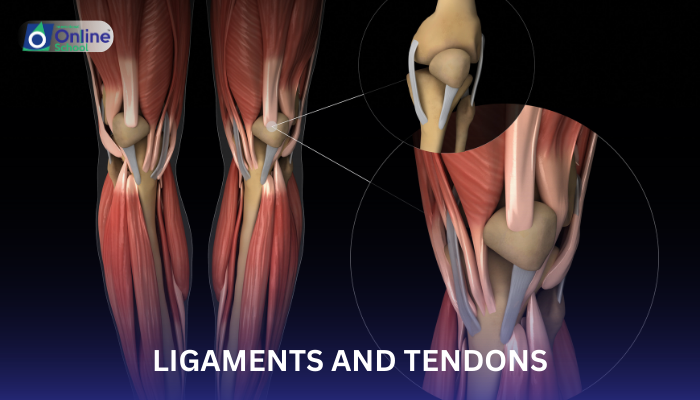
Ligaments: Tough, flexible bands of fibrous tissue that connect bones to other bones at joints. They are composed mainly of long, stringy collagen fibres that allow them to be stretchy and give them the strength to stabilize joints.
Tendons: Strong, non-elastic cords of collagen that connect muscles to bones. They are responsible for transmitting the force generated by muscles to bones, leading to movement.
ii. Functions of Ligaments and Tendons
Ligaments: Provide joint stability by limiting excessive movement and preventing dislocation. They also help guide joint motion and contribute to proprioception—awareness of the position and movement of the body.
Tendons: Enable movement by transferring the contractile force produced by muscles to bones. This allows for a wide range of controlled motions. Tendons can also act as springs to store and release energy, as seen in the Achilles tendon during running.
iii. Contribution to Joint Stability and Movement
Joint Stability: Ligaments are critical for stabilizing joints, especially in joints that have a wide range of motion like the knee and shoulder, where they help maintain proper alignment and prevent injuries.
Movement: Tendons are essential for locomotion and manipulation. They allow muscles to pull on bones to produce movement, and their efficiency is vital for the function of lever systems in the body.
In conclusion, ligaments and tendons are key components of the musculoskeletal system, each with a specialized function. Ligaments contribute to the stability and proprioceptive feedback of joints, while tendons transmit muscular forces to bones, enabling movement. Understanding the roles of these connective tissues is crucial for appreciating how the body achieves stable yet dynamic movement and how it responds to the mechanical demands of daily activities and exercise.
